
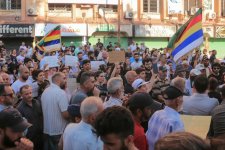
Hundreds of Druze protesters took to the streets of Sweida, Syria on Saturday, demanding self-determination in the largest demonstration since deadly sectarian clashes last month that left over 1,600 people dead. Some demonstrators waved Israeli flags to thank Israel for its military intervention during the July violence, marking what activists called an unprecedented shift for the Syrian Druze community.
The protests followed devastating clashes that erupted July 13 between Druze militias and armed Bedouin Sunni tribal groups in Sweida province, the heartland of Syria's Druze population. Syrian government forces intervened nominally to restore order but were accused by Druze groups of siding with the Bedouin tribes against the minority community.
Israeli Intervention Sparks Gratitude
Israel launched dozens of airstrikes on Syrian government forces and struck the Defense Ministry headquarters in Damascus after the clashes intensified. According to the Foundation for Defense of Democracies, Israeli officials justified the intervention by saying they would not allow harm to the Druze minority.
Footage from Saturday's protest showed armed Druze participants wearing military vests with Israeli flags, equipment that was reportedly sewn in the Israeli Druze village of Julis and transferred as humanitarian aid. "This is an unprecedented change for the Druze in Syria," activist Rayyan Maarouf told the Associated Press, noting this was the first time protesters adopted the theme of self-determination.
Ongoing Instability in Post-Assad Syria
The violence highlights the fragile transition in Syria following the collapse of the Assad regime in December 2024. The Syrian Observatory for Human Rights reported that atrocities were committed during the clashes, with execution-style killings of unarmed Druze civilians documented in multiple videos that surfaced online.
Syria's interim government under President Ahmed al-Sharaa established an investigative committee last month to examine the sectarian violence, with a report due within three months. The Druze, who branched off from Shiite Islam in the 10th century, comprise roughly half of the world's one million Druze population, with the remainder primarily in Lebanon and Israel.
The protests in Sweida were accompanied by similar demonstrations in nearby towns including Shahba and Salkhad, underscoring growing demands for international protection and justice for the minority community.
The protests followed devastating clashes that erupted July 13 between Druze militias and armed Bedouin Sunni tribal groups in Sweida province, the heartland of Syria's Druze population. Syrian government forces intervened nominally to restore order but were accused by Druze groups of siding with the Bedouin tribes against the minority community.
Israeli Intervention Sparks Gratitude
Israel launched dozens of airstrikes on Syrian government forces and struck the Defense Ministry headquarters in Damascus after the clashes intensified. According to the Foundation for Defense of Democracies, Israeli officials justified the intervention by saying they would not allow harm to the Druze minority.
Footage from Saturday's protest showed armed Druze participants wearing military vests with Israeli flags, equipment that was reportedly sewn in the Israeli Druze village of Julis and transferred as humanitarian aid. "This is an unprecedented change for the Druze in Syria," activist Rayyan Maarouf told the Associated Press, noting this was the first time protesters adopted the theme of self-determination.
Ongoing Instability in Post-Assad Syria
The violence highlights the fragile transition in Syria following the collapse of the Assad regime in December 2024. The Syrian Observatory for Human Rights reported that atrocities were committed during the clashes, with execution-style killings of unarmed Druze civilians documented in multiple videos that surfaced online.
Syria's interim government under President Ahmed al-Sharaa established an investigative committee last month to examine the sectarian violence, with a report due within three months. The Druze, who branched off from Shiite Islam in the 10th century, comprise roughly half of the world's one million Druze population, with the remainder primarily in Lebanon and Israel.
The protests in Sweida were accompanied by similar demonstrations in nearby towns including Shahba and Salkhad, underscoring growing demands for international protection and justice for the minority community.