On April 22nd, North Macedonians and Bulgarians nearly came to blows once again. The reason? Once more, the revolutionary figure of Jane Sandanski and the "memory war" surrounding his legacy!
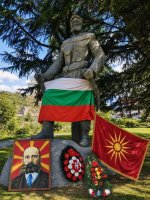
Commemorative events are held at his monument on the anniversary of his assassination. It is located in the village of Melnik in southwestern Bulgaria—or, for the North Macedonians, in "Pirin Macedonia," the third "unredeemed" territorial piece that they believe should be united with "Vardar Macedonia" (today’s North Macedonia) and "Aegean Macedonia" (Greek Macedonia). The monument stands near the spot where Sandanski was murdered by insurgents of the "right-wing," nationalist, pro-Bulgarian wing of the VMRO.
The problem dates back to the late 19th century, when identities in Macedonia functioned differently than they do today. The "Bulgarians" we are concerned with identified as such ecclesiastically and linguistically, yet simultaneously, some spoke of "Macedonia" as a distinct, independent socialist homeland.
National consciousness was not always stable or strictly nation-state-oriented. For the Slavic speakers, Vlachs, and Albanians of the region, it was often something intermediate, with political stance playing a defining role. This was especially true for the cadres of the revolutionary VMRO.
How did we get from the "Comitadji Left" to North Macedonian ethnogenesis?After World War II, Tito’s Yugoslav historiography needed historical figures to counter Bulgarian claims. At the same time, "Slavo-Macedonian" visionaries—seeking to build a separate "Macedonian" national identity upon their own "Rigas Feraios," Krste Misirkov—transformed the old "revolutionary of an independent and multi-ethnic Macedonia" into an "ethnic Macedonian." This was crafted gradually through schools, universities, monuments, and national mythology.
Commemorative events are held at his monument on the anniversary of his assassination. It is located in the village of Melnik in southwestern Bulgaria—or, for the North Macedonians, in "Pirin Macedonia," the third "unredeemed" territorial piece that they believe should be united with "Vardar Macedonia" (today’s North Macedonia) and "Aegean Macedonia" (Greek Macedonia). The monument stands near the spot where Sandanski was murdered by insurgents of the "right-wing," nationalist, pro-Bulgarian wing of the VMRO.
Why can't they untangle the knot of Sandanski’s national identity?
It is because his persona stands exactly at the crossroads where three different narratives collide: Bulgarian national history, modern North Macedonian national narrative, and the former supranational, "Slavo-Macedonian" anarcho-revolutionary tradition of late Ottoman Macedonia.The problem dates back to the late 19th century, when identities in Macedonia functioned differently than they do today. The "Bulgarians" we are concerned with identified as such ecclesiastically and linguistically, yet simultaneously, some spoke of "Macedonia" as a distinct, independent socialist homeland.
National consciousness was not always stable or strictly nation-state-oriented. For the Slavic speakers, Vlachs, and Albanians of the region, it was often something intermediate, with political stance playing a defining role. This was especially true for the cadres of the revolutionary VMRO.
The Life of a "Bulgarian" Revolutionary
Sandanski was born in 1872 in Vlahi, near Melnik, then part of the Ottoman Empire. His family belonged to the Bulgarian Exarchate circles, and he was raised within Bulgarian national networks. Almost all his contemporaries, even his enemies, considered him a Bulgarian revolutionary of Macedonia, despite his "democratic" sensitivities. His letters, organizations, and contacts were deeply embedded in the Bulgarian world of the era. From this perspective, modern Bulgarian historiography has a solid basis when presenting him as Bulgarian, at least in his early life.The "Macedonian Salad" of Identity
This is where the complexity regarding the ethnogenesis of modern North Macedonians begins. Sandanski was not a "Bulgarian nationalist" in the narrow modern sense. He didn't simply want the annexation of Macedonia by Bulgaria. He belonged to the so-called left-wing, federalist, or "centralist" faction of the VMRO.- The Federalist Vision: He supported an autonomous Macedonia within a Balkan Federation, where Bulgarians, other Slavs, Greeks, Vlachs, Turks, and Albanians—Christians and Muslims alike—would coexist politically.
- No "Macedonian Nation": At that time, there was no concept of a "Macedonian nation" as a strictly ethnic homeland.
- Contrast with the Supremacists (Verhovists): Unlike Sandanski, the Supremacists were linked to the Supreme Macedonian Committee in Sofia and promoted the Bulgarian state line: either direct unification with Bulgaria or Bulgarian control over the region. They were more nationalist, more statist, and certainly more pro-monarchy.
Radicalism and the Move Toward North Macedonian Ethnogenesis
Sandanski was fiercely anti-monarchist, influenced by the socialist and anarchist ideas of the time. He was skeptical of the Ilinden Uprising (viewing it as Bulgarian-driven and reckless), and even cooperated with the Young Turks after 1908, believing that the new constitutional regime would grant equality to the peoples of Macedonia. These actions infuriated the right-wing VMRO, who branded him a traitor.How did we get from the "Comitadji Left" to North Macedonian ethnogenesis?After World War II, Tito’s Yugoslav historiography needed historical figures to counter Bulgarian claims. At the same time, "Slavo-Macedonian" visionaries—seeking to build a separate "Macedonian" national identity upon their own "Rigas Feraios," Krste Misirkov—transformed the old "revolutionary of an independent and multi-ethnic Macedonia" into an "ethnic Macedonian." This was crafted gradually through schools, universities, monuments, and national mythology.