
This document is a fascinating piece of linguistic and political history. It shows the "Decision on the Macedonian Alphabet" (Решение за македонската азбука), officially adopted on May 3, 1945, and proclaimed shortly after.
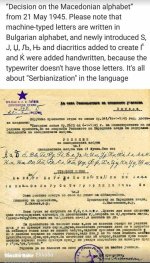
The image captures a pivotal moment in the codification of the modern Macedonian language within the framework of the newly formed Socialist Federal Republic of Yugoslavia.
The image captures a pivotal moment in the codification of the modern Macedonian language within the framework of the newly formed Socialist Federal Republic of Yugoslavia.
Historical Context: The 1945 Codification
Following World War II, the Yugoslav authorities sought to formalize a distinct Macedonian national identity. A language commission was tasked with creating a standardized alphabet. The handwritten additions you see in the document are the result of the commission choosing specific characters to represent unique Macedonian phonemes that weren't available on the standard Bulgarian-layout typewriters of the time.The "Serbianization" vs. "Autonomy" Debate
The caption’s mention of "Serbianization" refers to a long-standing historical debate regarding the influence of the Serbian Cyrillic script on the Macedonian one. Here is how those specific letters break down:- Influence from Serbian (Vuk Karadžić’s script): The letters Ј (j), Љ (lj), Њ (nj), Ђ (dj), and Ћ (tj) were borrowed directly from the Serbian alphabet.
- Unique Macedonian Additions: To keep the language distinct from Serbian, the commission modified the Serbian letters Ђ and Ћ into Ѓ (ǵ) and Ќ (ḱ).
- The Letter Ѕ (dz): This is a unique feature of the Macedonian alphabet, representing a sound found in Old Church Slavonic but absent in modern Serbian and Bulgarian standards.
Why the Handwritten Letters?
The note in the image is correct about the technical limitations. Most printing presses and typewriters in the region at that time were configured for Bulgarian or Old Church Slavonic layouts. Because the Macedonian alphabet was being "born" officially in May 1945, the specific characters that deviated from the Bulgarian standard—like Ѕ, Ј, and the palatalized Ѓ and Ќ—had to be inked in by hand until new typebars could be manufactured.Summary of the Alphabet Structure
The final result was an alphabet of 31 letters, designed to be strictly phonetic (one letter per sound).| Origin | Letters Included |
| Common Cyrillic | А, Б, В, Г, Д, Е, Ж, З, И, К, Л, М, Н, О, П, Р, С, Т, У, Ф, Х, Ц, Ч, Ш |
| Serbian Borrowings | Ј, Љ, Њ, Џ |
| Macedonian Specific | Ѓ, Ќ, Ѕ |